
I need to add a qualifier to the post below. I repeated the test, but could not reproduce the pink colour. The second test used more vinegar so perhaps the dilution factor was such that the colour is not visible. I also wondered if the vinegar may interfere with the reaction. However, taking one of the test cotton buds and wiping it on a lead came did produce a colour change. I have also seen it suggested that this test will only work with crushed glass or after leaving the vinegar in place for a month.
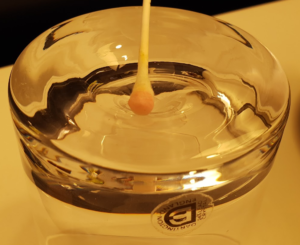
I heard that lead can be detected in lead crystal glassware by using white vinegar. I tried this by leaving a about 3ml of vinegar overnight in a dimple on the bottom of a 24% lead glass. I then took some of the reagent from a LeadCheck swab, put in on a cotton bud and dipped that in the vinegar as well as wiping on the glass where the vinegar had been applied. The cotton bud turned pink to show lead was detected although a pale pink due, presumably, because of the dilution by the liquid.
I also found that the inside of a glass that had gone cloudy, by going through the dishwasher, just about showed a colour change with the LeadCheck reagent. Not a strong reaction, but enough to suspect that lead could be released into any acidic liquid placed in it, but of an indeterminate quantity.
I did a similar test with a plastic tupperware cup that LeadSafeMama said had lead. However, I put the vinegar in the dimple on the bottom of the cup and let it completely evaporate. My theory was that if any lead did leach from the cup, it would still be there after evaporation of the liquid. In my case, the dimple on the bottom of the cup tested negative for lead. So if my theory is correct, no lead leached from the cup even thought it was present in the plastic per the XRF reading by LeadSafeMama. I may try the test again on some glasses that are leaded crystal and then some that may or may not be.